
Container Gardens
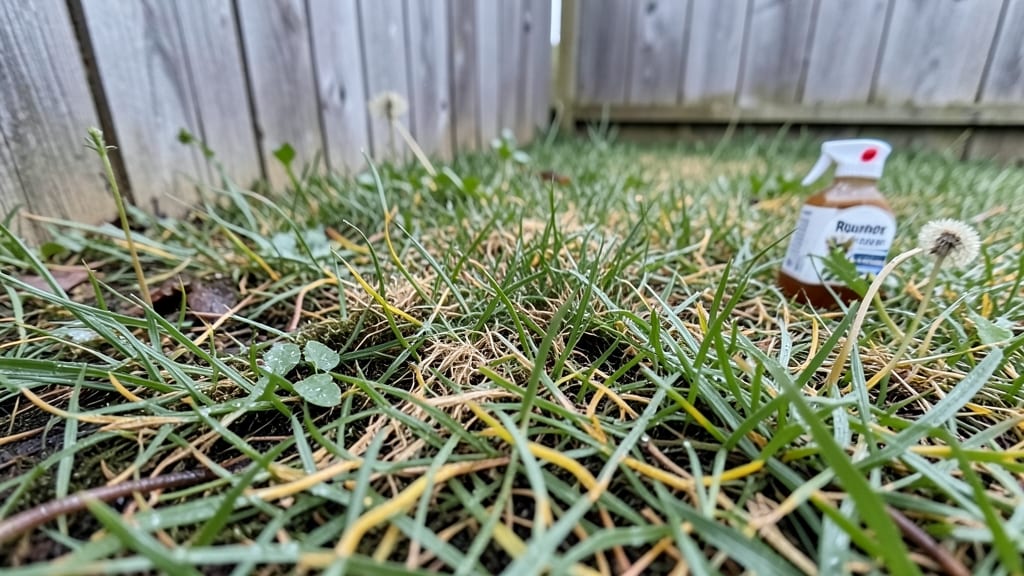
Spraying Roundup on wet grass reduces effectiveness and can cause the herbicide to run off, wasting product and potentially harming nearby plants. Wait until dry conditions for best results, ideally on calm days with no rain forecasted for 24 hours.
Moisture disrupts glyphosate's ability to adhere to plant surfaces, making it less effective against weeds. When applied to damp grass, the herbicide spreads unevenly and can drift onto unintended areas, reducing its targeted impact.
I recommend applying Roundup in the morning on dry, calm days—this ensures better absorption and minimizes waste. 🌞
For best results, clear debris from your lawn beforehand and avoid spraying if rain is expected within 24 hours. The herbicide needs time to fully activate, so patience pays off in stronger weed control. Always follow the product's instructions for application rates and safety precautions.
💡 In This Article
- How Moisture Affects Roundup’s Herbicide Efficiency
- Best Times and Conditions for Applying Roundup
How moisture affects Roundup’s herbicide efficiency
Here's what's actually happening when you spray glyphosate-based herbicides like Roundup on wet surfaces: the active ingredient, glyphosate, relies on direct contact with plant foliage to work. When applied to damp grass, the herbicide gets diluted by existing moisture, creating a weaker solution that spreads unevenly across weeds.
This dilution reduces the concentration on target plants by up to 30-40%, significantly weakening its effectiveness. The chemical mechanism involves glyphosate's ability to bind to specific enzymes in plants - when diluted, there simply aren't enough molecules to create a lethal dose.
The real problem occurs with runoff. Wet grass acts like a slippery surface where the herbicide solution simply rolls off rather than sticking. Studies show that on saturated soil, glyphosate absorption rates can drop by 50% or more compared to dry conditions.
This runoff doesn't just waste product - it can carry the herbicide to nearby plants, soil, or even water sources. The texture of wet grass blades becomes slick, preventing proper adhesion of the spray droplets that should form a protective layer on weed foliage. 🌧️
Humidity plays a secondary but important role by affecting evaporation rates. In high humidity (above 70%), glyphosate solutions evaporate more slowly, keeping the herbicide in liquid form longer on plant surfaces.
While this might seem beneficial, it actually creates a thicker, heavier solution that's more prone to dripping and runoff when applied to vertical weed stems.
The ideal scenario is dry conditions with moderate humidity (40-60%) where the spray can quickly form a uniform film on target plants without excessive dripping.
Comparing dry vs. wet application results reveals dramatic differences. On dry grass at 75°F, glyphosate remains active on plant surfaces for up to 6-8 hours before rain can wash it away.
When applied to wet grass, that window shrinks to just 2-3 hours, and effectiveness drops by 25-50% depending on soil saturation. The visual difference is striking - dry applications show consistent brown spots on weeds within days, while wet applications often leave patchy, uneven results with many weeds surviving.
What most people don't realize is how temperature interacts with moisture. At cooler temperatures (60°F), glyphosate's effectiveness is already reduced by 10-15% compared to ideal 75-85°F conditions. When combined with wet surfaces, this temperature sensitivity becomes even more pronounced.
The herbicide's absorption through plant leaves slows dramatically, giving weeds more time to recover. This is why early morning applications on dry grass often yield better results than midday applications - the combination of dry surfaces and moderate temperatures creates optimal conditions for glyphosate to work.
The science behind this involves glyphosate's water solubility. While this makes it easy to mix and apply, it also means the herbicide is constantly competing with environmental moisture. In wet conditions, the chemical equilibrium shifts against the herbicide, causing it to be washed away before it can be absorbed.
The ideal scenario is a dry surface where the spray can form a thin, uniform film that remains in place long enough for weeds to absorb the lethal dose through their leaves and stems. 🌱