
Lawn
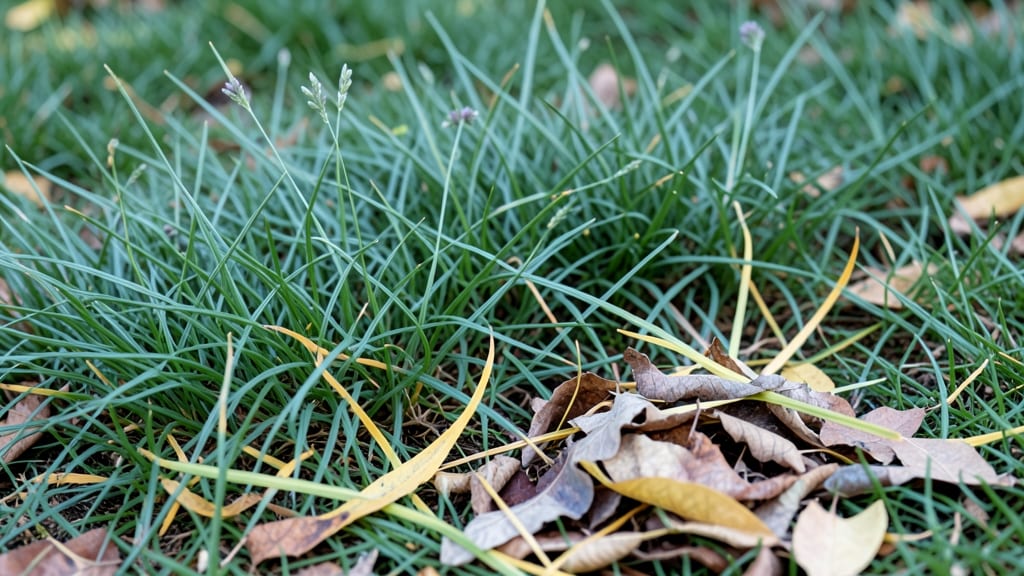
Are leaves bad for grass? They’re not inherently harmful, but thick accumulations suffocate blades, block sunlight, and trap moisture, creating ideal conditions for fungal growth and root suffocation over time. Mulching or raking helps maintain a balance between their natural fertilizer benefits and potential risks.
Leaves actually provide some benefits to grass—like adding organic matter that improves soil fertility over time.
However, the key issue is thickness: a layer thicker than ¼ inch can block sunlight and prevent photosynthesis, while also trapping excess moisture that encourages mold and disease. 🌿 I’ve seen lawns recover quickly after a single heavy leaf drop, but neglecting them for weeks can leave brown patches that take months to bounce back.
What makes this tricky is that different leaf types decompose at different rates—oak leaves take longer to break down than maple leaves, for example.
In wet climates, leaves can create a waterlogged layer that smothers grass roots entirely, while in drier areas, they might just dry out and become a nuisance. The solution often depends on your local climate and how quickly your lawn can recover.
💡 In This Article
- How Fallen Leaves Affect Grass Health Mechanically
- Best Leaf Management Strategies for Lawn Care
How fallen leaves affect grass health mechanically
When leaves pile up on grass, they create a physical barrier that disrupts critical gas exchange. A layer just 1/4 inch thick can reduce oxygen flow by up to 30%, while thicker layers (over 1/2 inch) can drop oxygen levels below 10%—the threshold where roots start suffocating.
This happens because leaves trap moisture against the grass blades, creating an anaerobic (oxygen-deprived) environment that weakens roots and invites fungal pathogens like brown patch disease. 🌱 The problem worsens in cool, damp climates where decomposition slows.
Leaf type plays a surprising role in how quickly damage occurs. Oak leaves, with their thick, leathery texture and high tannin content, take 6-12 months to decompose completely, while maple leaves break down in 3-6 months.
The tannins in oak leaves also lower soil pH over time, creating acidic conditions that stress grass roots. In contrast, maple leaves decompose faster but can form dense mats that trap moisture longer. This variation explains why some lawns show immediate damage while others seem unaffected for weeks.
The trapped moisture creates another critical issue: excessive humidity at the soil surface. When leaves block sunlight, grass blades can't photosynthesize efficiently, but the trapped moisture creates ideal conditions for fungal spores to germinate.
I've seen lawns develop dollar spot fungus within 10-14 days of heavy leaf accumulation in humid climates. The fungus thrives in these microclimates because the leaf layer maintains 90%+ humidity near the soil, while the grass above struggles with less than 30% sunlight penetration. 🌧️
Climate and leaf volume interact in complex ways. In northern regions, where leaves often stay intact through winter, they can insulate grass and protect roots from freeze-thaw cycles. But in southern climates, where decomposition happens faster, leaves can create a slimy, anaerobic sludge within weeks.
The key difference is temperature: leaves decompose 3x faster at 70°F than at 50°F, which is why spring leaf cleanup is often more urgent than fall cleanup in warmer areas.
Here's what's actually happening at the root level: when leaves block sunlight, grass blades stop producing enough chlorophyll, leading to chlorosis (yellowing).
Meanwhile, the trapped moisture creates a perfect storm for thatch buildup, a dense layer of dead grass and roots that prevents water and nutrients from reaching living blades. In extreme cases, this can kill grass entirely within 4-6 weeks if not addressed. The good news?
Most grass types can recover if leaves are removed before this threshold is crossed.
One often-overlooked factor is how leaves affect soil temperature. A thick leaf layer can insulate soil, keeping it 5-10°F warmer in winter or 5-10°F cooler in summer than bare soil. While this might seem beneficial, the temperature fluctuations stress grass roots and disrupt their natural growth cycles.
This is why lawns often show uneven recovery after leaf removal—some areas bounce back quickly while others lag behind due to these temperature imbalances. 🌡️